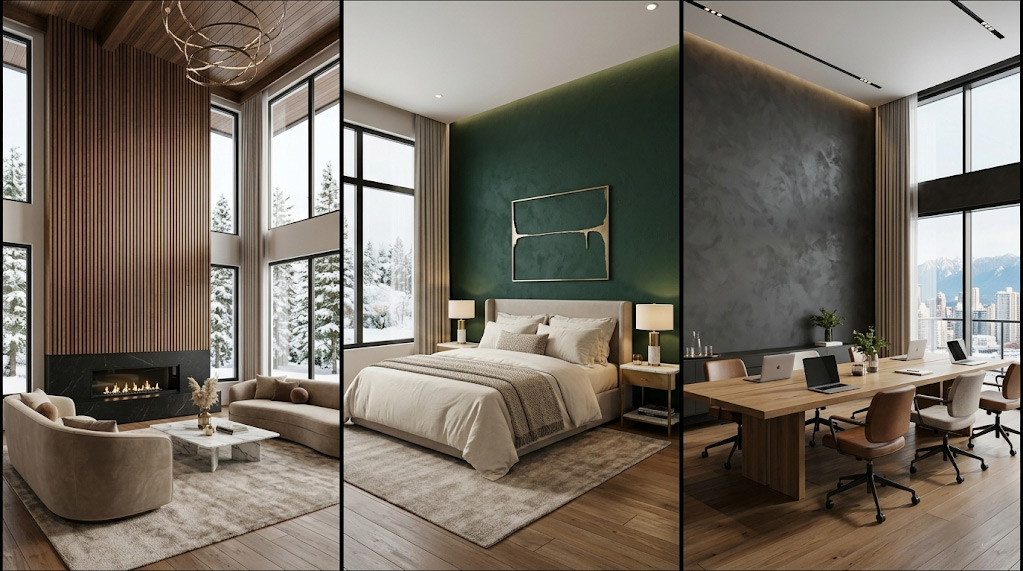
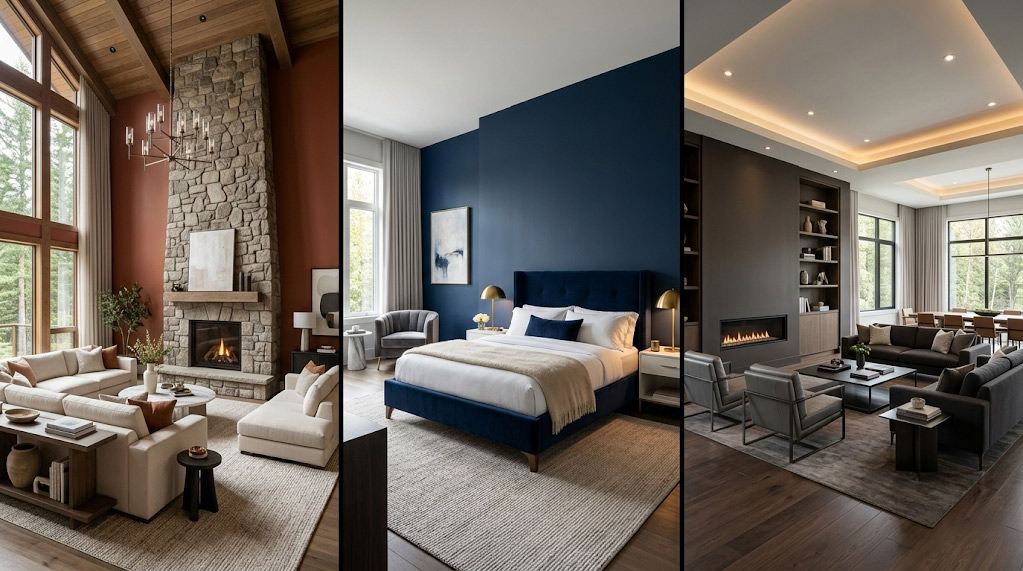
1. Introduction: The Canadian Interior Landscape in 2026
The trajectory of Canadian interior design has shifted dramatically as we approach 2026, moving away from the austere, cool-toned minimalism that defined the previous decade toward an aesthetic characterized by warmth, tactile complexity, and psychological sanctuary. This evolution, often described by industry forecasters as “Curated Nostalgia” or “Comforting Chaos,” represents a fundamental change in how Canadians interact with their living spaces. Homeowners in major metropolitan centers—specifically Toronto, Vancouver, and Montreal—are no longer seeking the showroom perfection of high-gloss white surfaces. Instead, there is a collective yearning for environments that feel grounded, organic, and resilient against the harsh environmental dualities of the Canadian climate.
The concept of the accent wall has matured alongside this aesthetic shift. It is no longer sufficient to simply paint a single wall a bold color to create a focal point. In 2026, the successful feature wall is an architectural statement that integrates texture, acoustic performance, and advanced material science. It serves a dual purpose: anchoring the design narrative of the room while addressing the functional challenges of the Canadian home, such as noise transfer in high-density condos and material stability amidst extreme humidity fluctuations. The harsh reality of the Canadian climate—oscillating between the humid, sub-tropical heat of Southern Ontario summers to the bone-dry, sub-zero conditions of Prairie and shield winters—demands materials that possess both visual warmth and extraordinary structural resilience.
This comprehensive report evaluates the premier products available to Canadian homeowners for accent wall installation in 2026. It moves beyond superficial trend analysis to offer a deep technical assessment of material performance, analyzing how specific paints, wood composites, and wallcoverings react to local environmental stressors. From the hygroscopic properties of engineered wood slats in Alberta’s dry winters to the adhesion challenges of peel-and-stick wallpaper in Vancouver’s humid coastal air, this guide synthesizes data to determine the best-in-class products for the discerning homeowner.
2. Are Accent Walls Still in Style for 2025?
Yes, accent walls remain a staple of modern Canadian design, but the trend has shifted toward texture, matte finishes, and tactile materials rather than high-contrast color blocks.

2.1 The Physics of Canadian Interiors: Environmental Stressors and Material Selection
To understand why certain accent wall products fail while others endure, one must first appreciate the unique physics of the Canadian interior environment. Unlike homes in more temperate zones, Canadian residences act as pressurized vessels that undergo significant expansion and contraction cycles annually. This “heaving” of the home environment places immense stress on finishes, particularly those adhered to or installed upon exterior-facing walls.
2.2 The Hygroscopic Cycle: Humidity and Material Movement
The primary enemy of any accent wall installation in Canada is moisture—or the lack thereof. Wood and paper products are hygroscopic, meaning they absorb and release moisture to reach Equilibrium Moisture Content (EMC) with their surrounding environment.
In regions like the Greater Toronto Area (GTA) and Montreal, summers can see indoor Relative Humidity (RH) spike above 60%, causing porous materials to absorb water and expand. Conversely, during the deep freeze of winter, forced-air heating systems drive indoor RH down to as low as 15-20%, effectively baking the moisture out of interior finishes. This oscillation creates a mechanical phenomenon known as “movement.”
For a solid wood plank installed on a wall, this movement is significant. A 5-inch wide plank of solid oak can shrink by nearly 1/8th of an inch across its width during a dry winter. Multiply this across a 12-foot accent wall, and the cumulative shrinkage can result in inches of exposed gaps, cracked caulking, and popped fasteners. This reality dictates that solid wood is rarely the optimal choice for Canadian accent walls, pushing the market toward engineered solutions that offer dimensional stability.
2.3 Thermal Bridging in High-Rise Condos
A distinct challenge faces the urban condo dweller in Vancouver and Toronto. Many high-rise buildings feature concrete party walls or exterior walls with varying degrees of insulation. In winter, these walls can become “thermal bridges,” conducting cold from the outside in. If an accent wall material—such as a peel-and-stick vinyl wallpaper—is applied to a wall that is significantly colder than the room air, the adhesive bond can become brittle and fail. Furthermore, covering a cold concrete wall with a non-breathable material can trap condensation behind the finish, leading to hidden mold growth. Therefore, product selection must account for breathability (permeability) and thermal tolerance.
2.4 The Acoustic Imperative
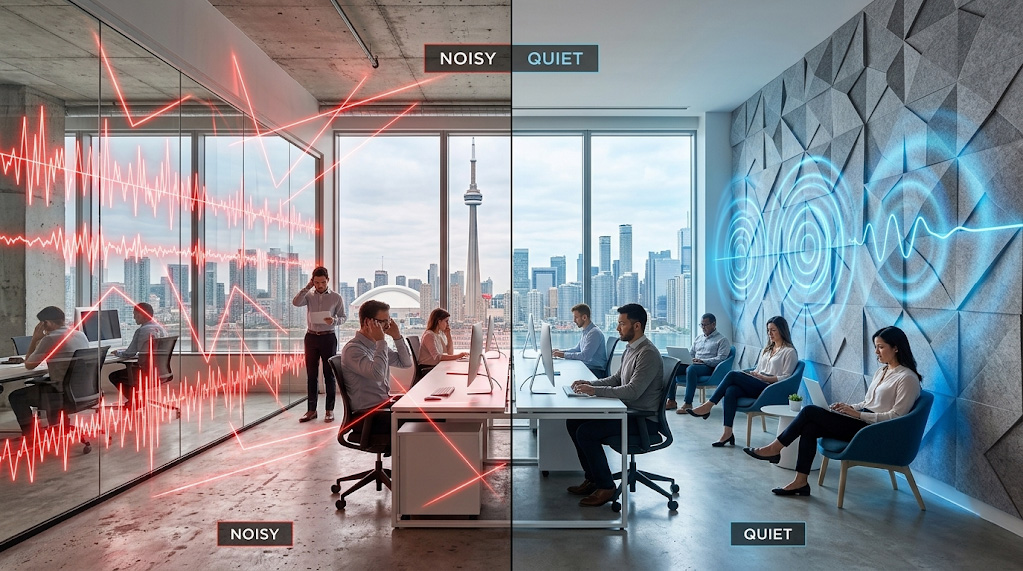
Beyond thermal and moisture concerns, the acoustic environment of the modern Canadian home has become a priority. The “Work From Home” shift has necessitated quieter interiors. In open-concept homes and glass-walled condos, sound reflects off hard surfaces (drywall, tile, glazing), creating “slap echo” and poor speech intelligibility. The accent wall in 2026 is increasingly tasked with dampening this reverberation. This functional requirement has propelled Acoustic Slat Wood Panels to the forefront of the market, as they combine the desired “warm” aesthetic with measurable noise reduction coefficients (NRC).
3. Wood Slat and Acoustic Panels: The Premium Standard for 2026
Wood slat walls have evolved from a niche architectural detail to the dominant feature wall product in Canadian homes. However, the market is bifurcated between high-performance engineered solutions and lower-quality cosmetic imitations. For 2026, the industry standard is the Acoustic Slat Wood Panel, typically featuring a PET felt backing, an MDF core, and a real wood veneer.

3.1 Engineered Stability vs. Solid Wood
As established, solid wood poses significant risks in the Canadian climate. The engineered acoustic panel solves the hygroscopic challenge through its construction. The core, usually made of high-density fiberboard (MDF), is far more dimensionally stable than solid lumber. The wood veneer provides the aesthetic warmth of oak or walnut without the mass of material that would be susceptible to warping. The felt backing acts as a flexible substrate, allowing the individual slats to “float” slightly, accommodating minor thermal expansion without buckling.
3.2 Acoustic Performance Metrics
The acoustic benefit of these panels is twofold: absorption and diffusion. The hard wood slats break up sound waves (diffusion), scattering them to reduce echo. The felt backing, often made from recycled plastic bottles, absorbs sound energy (absorption) in the mid-to-high frequency range—the range of human speech.
For a panel to be effective in a Canadian condo, it typically needs an NRC rating of 0.8 or higher, meaning it absorbs 80% of the sound that hits it. This makes these panels exceptionally suited for media walls, home offices, and primary bedrooms where tranquility is paramount.
3.3 Comparative Analysis of Top Brands Available in Canada
The Canadian market offers several distinct brands, each with unique value propositions regarding supply chain reliability, finish quality, and acoustic density.
| Brand / Product | Core Material | Felt Composition | Acoustic Rating | Primary Advantage for Canadian Homes |
| Artmur (Quebec/Ontario) | Recycled Wood / MDF | Recycled PET | NRC 0.8 (High) | Best Overall Reliability. Being Canadian-based reduces the risk of shipping damage (broken corners are common with imports). Meets strict Canadian fire codes (Class A options available).9 |
| Andor Willow (Canadian) | Wood Composite / MDF | Premium Felt | High | Design Flexibility. Specializes in diverse finishes like Smoked Oak and offers “paintable” fluted panels, allowing homeowners to color-match walls to millwork.13 |
| VIP Classic Moulding | Low-VOC MDF | Recycled Felt | High | Installation Service. A top choice for GTA homeowners requiring professional installation, particularly for complex cuts around electrical outlets and bulkheads.8 |
| MSI Modern Slat (Home Depot) | MDF + Veneer | Standard Fiber | Moderate | Accessibility. Available off-the-shelf at Home Depot Canada. Good for budget projects, though user reviews suggest the felt is less dense than premium boutique brands.14 |
| The Wood Veneer Hub (WVH) | Sustainable MDF | Recycled Felt | Class A | Luxury Finishes. Offers high-end veneers like American Oak and “Ultra Light” flexible versions for curved walls. High aesthetic fidelity.11 |
Brand Spotlight: Artmur
Artmur has established itself as a leader in the Quebec and Ontario markets by addressing the specific logistical challenges of shipping heavy panels. Their panels are manufactured with a focus on local standards, ensuring they meet the National Building Code requirements for flame spread—a critical factor for high-rise condo renovations. Their use of recycled materials also appeals to the growing eco-conscious demographic in Vancouver and Montreal.9
Brand Spotlight: Andor Willow
Andor Willow distinguishes itself through customization. In 2026, the trend of “Panel Drenching” (painting the panel and ceiling the same color) is significant. Andor Willow’s paintable fluted panels allow designers to achieve this monochromatic textural look without the difficulty of priming standard laminate panels. Their “Willow” line is engineered to withstand the dryness of Canadian winters without checking or cracking.13
3.4 Installation Methodologies for Canadian Substrates
The installation of these panels varies significantly depending on the wall structure.
Drywall (Wood Studs):
For standard detached homes, panels can be installed using black drywall screws driven through the felt backing directly into the studs or drywall anchors. This method is reversible and secure.15
Concrete (High-Rise Condos):
Drilling into concrete party walls in condos is often restricted by Strata bylaws due to the risk of hitting electrical conduits or compromising structural integrity.
- Adhesive Method: Lightweight acoustic panels can be installed using heavy-duty construction adhesive (e.g., PL Premium) applied directly to the concrete or drywall surface. This creates a permanent bond but avoids drilling.
- Furring Strip Method: For uneven concrete surfaces (cinder block), installing a framework of wood furring strips provides a level surface. This also creates a small air gap behind the panels, which can be beneficial for managing thermal bridging and running cables for wall-mounted televisions.15
4. High-Performance Paint Systems: The 2026 Color Authority
While wood panels dominate the “texture” category, paint remains the most versatile tool for accent walls. However, the chemical composition of paint in 2026 has advanced to offer durability that rivals harder surfaces. The debate for the best accent wall paint in Canada centers on two premium lines: Benjamin Moore Aura and Sherwin-Williams Emerald.

4.1 The 2026 Palette: Warmth and Biophilia
The era of cool greys is effectively over. The 2026 palette is defined by “earthy, grounded neutrals” and deep, organic accents.
- Warm Neutrals (The Base): Colors like Benjamin Moore Edgecomb Gray and Sherwin-Williams Universal Khaki are the new foundations. These shades contain subtle yellow and red undertones that counteract the flat, blue-spectrum light of Canadian winters, making spaces feel inviting rather than clinical.
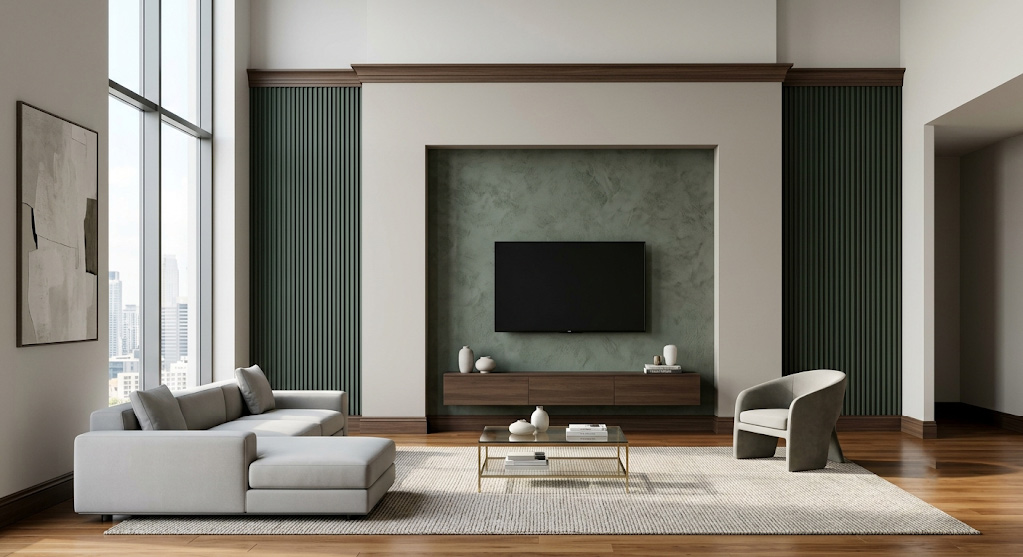
- Deep Greens (The Accent): Dark green has emerged as the “New Neutral.” Shades like Regent Green and Evergreen Fog offer the drama of black but with a biophilic connection to nature that is psychologically restorative during long winters.
- Brown and Clay: Following the “70s Revival” and “Comforting Chaos” trends, rich browns like Urbane Bronze and terracotta tones are being used to anchor spaces, often paired with vintage wood furniture.
4.2 Technical Comparison: Aura vs. Emerald
For a deep-color accent wall, the quality of the paint base is critical. Cheap paints use grey or black tints to achieve dark colors, which can result in a muddy, flat appearance. Premium paints use clear resins and specific colorants to maintain luminosity.
Benjamin Moore Aura (Matte/Eggshell):
- Color Lock Technology: Aura uses a proprietary resin system that encapsulates the pigment particles. This provides exceptional “rub-off” resistance. In deep colors (like navy or forest green), standard matte paints can “burnish” (develop shiny spots) if rubbed. Aura Matte is formulated to resist this, making it the premier choice for low-sheen, high-depth accent walls in living rooms.
- Coverage: Aura is known for its extreme hide, often covering a light wall with a dark color in fewer coats than competitors.
Sherwin-Williams Emerald (Matte/Satin):
- Acrylic Hardness: Emerald cures to a harder film than most architectural paints. It has superior resistance to blocking (sticking) and water spotting.
- Antimicrobial: Emerald contains agents that inhibit the growth of mold and mildew, making it the superior choice for accent walls in basements, bathrooms, or mudrooms where humidity levels fluctuate.
- Leveling: Professional painters often favor Emerald for its flow and leveling properties, which result in a smoother finish free of brush marks, particularly on trim or wainscoting.
The Verdict:
For a living room or bedroom accent wall where the priority is depth of color and a velvety matte finish, Benjamin Moore Aura Matte is the superior product. Its ability to hold deep pigments without burnishing is unmatched.
For high-traffic areas, hallways, or bathrooms, Sherwin-Williams Emerald is the better choice due to its hard, scrubbable finish and moisture resistance.
4.3 Limewash: The Organic Alternative
Limewash has surged in popularity for its ability to add “cloud-like” texture without physical bulk.
- Composition: Made from crushed limestone and water, it is zero-VOC and breathable.
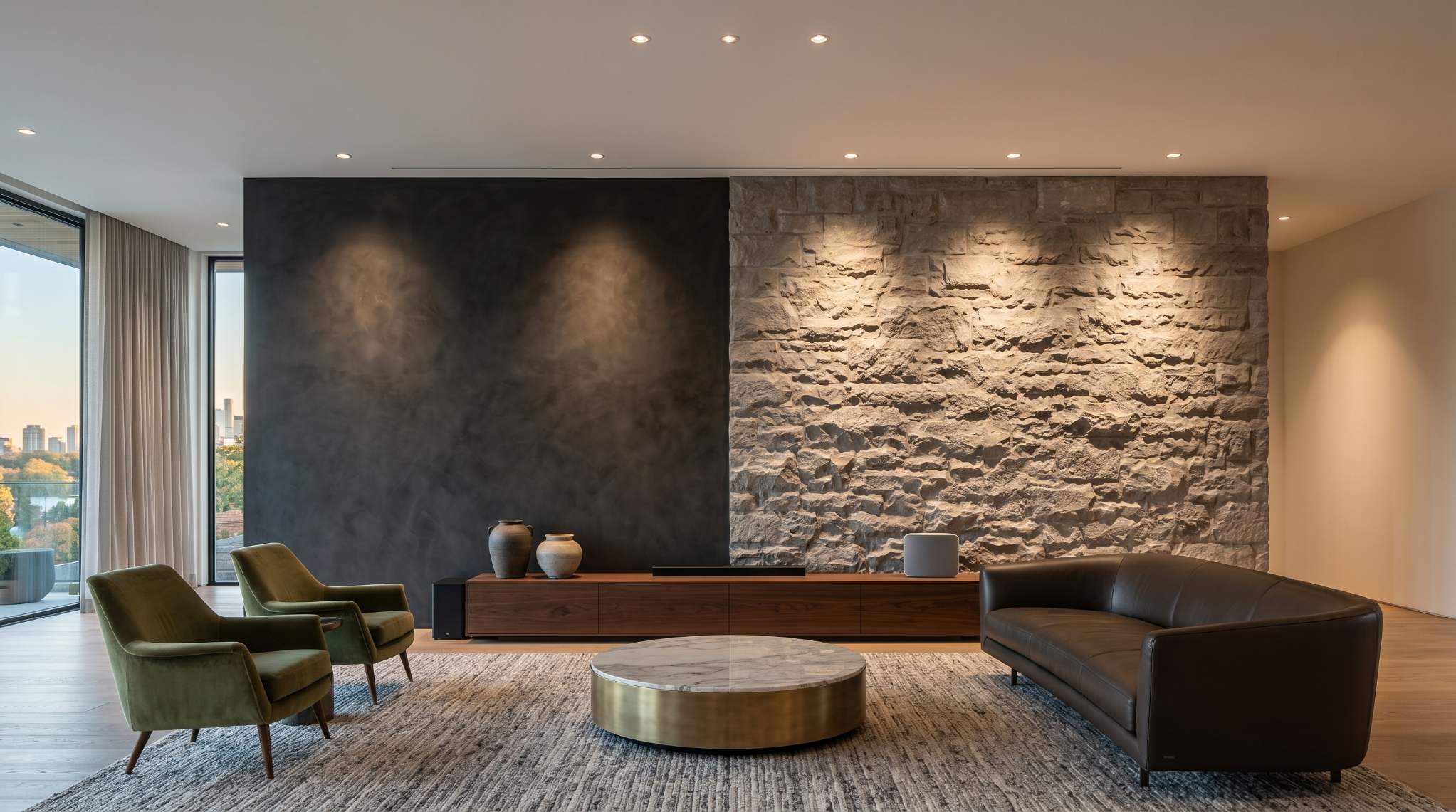
- Pros: It creates a mottled, suede-like finish that refracts light beautifully. It is chemically compatible with the plaster and brick found in older Toronto and Montreal homes, allowing the wall to breathe.
- Cons: It is difficult to clean (water stains it) and difficult to touch up. It is a “living finish” that patinas over time.
- Best Use: Low-traffic areas like primary bedrooms or meditation spaces where the aesthetic of “imperfect beauty” is desired.
5. Wallpaper Systems: Peel-and-Stick vs. Traditional Paste
The “Playful Maximalism” trend has brought wallpaper back into the spotlight. However, the specific environmental conditions of Canadian homes dictate which type of wallpaper is viable.

5.1 The Vulnerability of Peel-and-Stick (Vinyl)
Peel-and-stick wallpaper is often marketed as a renter-friendly solution. It uses a pressure-sensitive adhesive. However, in the Canadian context, it faces two failure modes:
- Cold Wall Delamination: In winter, if a wallpaper is applied to an exterior-facing wall that is poorly insulated, the temperature of the drywall drops. Cold inhibits the tack of the adhesive, leading to peeling at the edges and corners.
- Heat/Humidity Failure: In humid summers (or bathrooms), moisture can penetrate the seams. If the vinyl is impermeable, it can trap this moisture, leading to bubbles or mold. Conversely, extreme heat (near radiators) can soften the adhesive, causing the sheets to slide.
5.2 Top Wallpaper Brands for Canadian Homes
1. NuWallpaper (Brewster Home Fashions)
- Availability: Widely stocked at Home Depot Canada, making it accessible.
- Performance: Reviews indicate the vinyl is thick and forgiving, capable of hiding minor wall textures (orange peel). However, pattern matching can be difficult as there is often no overlap printed on the strips, requiring precise butt-joints.
- Best For: Powder rooms and nurseries where the commitment level is lower.
2. RoomMates
- Performance: Known for robust adhesion. Users report success in high-humidity environments like bathrooms without peeling. The material is reusable and can be peeled off and re-stuck multiple times during installation, which is a significant benefit for DIYers.
- Durability: High. It withstands cleaning and incidental moisture better than paper-based options.
3. Traditional “Paste-the-Wall” (Non-Woven)
- The Professional Choice: For long-term installations (5+ years), traditional non-woven wallpaper is superior.
- Mechanics: The paste (applied to the wall) creates a mechanical bond with the paper substrate that is stronger and more thermally stable than the chemical tack of peel-and-stick.
- Dimensional Stability: Non-woven papers are engineered not to expand or contract when wet with paste, ensuring seams stay tight even as the home’s humidity fluctuates.
- Brand Recommendation: Graham & Brown offers an extensive range of paste-the-wall papers available in Canada that combine durability with high-design aesthetics.
Recommendation:
For renters or temporary style updates, RoomMates peel-and-stick is the safest bet due to its balance of adhesion and removability.
For permanent accent walls in main living areas, specifically on exterior walls, Traditional Paste-the-Wall wallpaper is the only responsible choice to ensure longevity through Canadian winters.
6. Alternative Materials: Microcement and Stone
As the industrial aesthetic softens into “Archaic Modernity,” materials that mimic raw earth and stone are gaining traction.
6.1 Microcement: The Seamless Stone Look
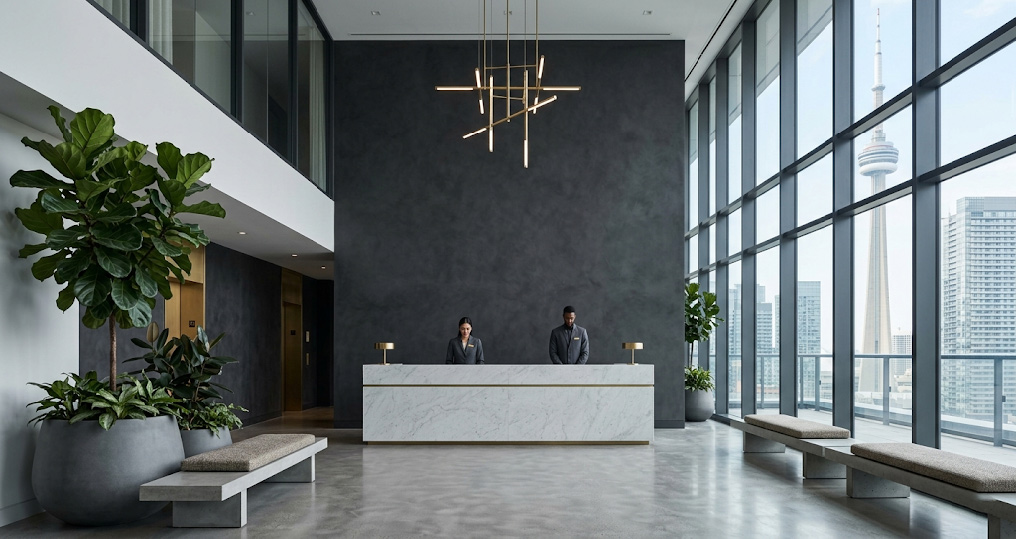
Microcement offers a continuous, joint-free surface that mimics concrete or stone. It is warm to the touch (unlike real concrete) and can be tinted to any earthy hue.
- The Risk: Microcement is rigid. If the substrate beneath it moves—as wood-framed Canadian houses do during seasonal settling—the microcement will crack.
- The Solution: Successful installation requires a “flexible” microcement system reinforced with fiberglass mesh. Brands like Kibitec or X-Bond offer systems designed to bridge minor substrate movement.
- Suitability: This is strictly a professional-install product. DIY application often results in visible trowel marks and delamination. It is ideal for fireplace surrounds or bathroom feature walls where water resistance is required.
7. Strategic Design: Placement and Proportion
Selecting the right product is only half the battle; placing it correctly is the other. In 2026, the placement of accent walls follows the principle of “Intentionality.”
7.1 The 60-30-10 Rule
To prevent an accent wall from feeling like an afterthought, it must be integrated into the room’s color story.
- 60%: The dominant color (walls, large rugs). In 2026, this is likely a warm white or soft greige.
- 30%: The secondary color (furniture, curtains).
- 10%: The accent color (the feature wall).
The key is that the accent color must appear elsewhere in the room—in throw pillows, art, or a rug—to tie the wall to the space.
7.2 Ideal Locations for 2026
- The Primary Bedroom Headboard: This remains the number one location. A dark, textured wall (slats or deep green Aura paint) creates a “cocooning” effect that signals rest. The acoustic benefits of slat walls are particularly valuable here for insulating against household noise.
- The “Zoom” Background: In the post-pandemic era, the wall behind the home office desk is a critical design element. Textured panels or wainscoting provide a professional backdrop that paint alone cannot achieve.
- The Media Wall: A dark accent wall (e.g., Black Magic or Iron Ore) behind a television camouflages the screen when it is turned off, reducing visual clutter and enhancing the contrast of the image when on.

7.3 Locations to Avoid
- Window Walls: Placing a dark accent color on a window wall creates backlighting, which causes the wall to appear silhouetted and black rather than its true color. It also strains the eyes.
- Small, Asymmetrical Walls: Highlighting a wall with odd angles or bulkheads often draws attention to architectural flaws rather than features.
8. Regulatory and Legal Considerations for Canadian Homeowners
For the millions of Canadians living in Strata corporations (condos) or co-ops, the installation of accent walls is governed by bylaws.
8.1 Ownership and “Betterments”
In a standard strata unit, the owner owns the “finish” of the wall inwards. The drywall itself may be unit property or common property depending on the specific strata plan, but the studs and concrete behind it are almost always common property.
- Implication: You can generally paint or wallpaper without permission. However, attaching heavy millwork or slat panels that require drilling deep into the common property (concrete party wall) may require an “Alteration Agreement” and Board approval.
8.2 Fire Ratings in High-Rise Buildings
High-rise buildings have strict codes regarding “combustible load.” Installing a wall covered in untreated wood pallets (a popular DIY trend) creates a significant fire hazard.
- Compliance: Homeowners must ensure that any wood paneling installed covers less than the maximum allowable percentage of the wall area defined by the fire code, or use materials with a Class A flame spread rating. Brands like Artmur and reputable acoustic panel suppliers provide CAN/ULC-S102 certification data, which should be submitted to the Condo Board if requested.
8.3 Noise Bylaws
Most stratas have strict bylaws regarding floor coverings (requiring carpets) to prevent noise transfer. Interestingly, acoustic accent walls are often viewed favorably by Boards because they reduce noise transfer. If you are renovating a condo, pitching a wood slat wall as a “sound dampening improvement” can help expedite approval.
9.The Verdict for 2026
The landscape of accent wall products for Canadian homes in 2026 is defined by a convergence of aesthetic warmth and technical performance. The days of the simple “feature wall paint” are yielding to complex, textured installations that engage the senses and improve the comfort of the home.
Final Recommendations by Use Case
- For the Design-Forward Homeowner:
- Top Pick: Acoustic Slat Wood Panels (Walnut or White Oak).
- Why: They perfectly capture the 2026 zeitgeist of “Maximum Dimension” and “warmth.” They offer functional acoustic benefits and, being engineered, are the only wood product stable enough for wide-scale installation in the Canadian climate.
- Brand: Artmur for reliability and code compliance; Andor Willow for custom design projects.
- For the Color Purist:
- Top Pick: Benjamin Moore Aura Matte.
- Why: For deep, moody accent walls (greens, charcoals), its proprietary Color Lock technology prevents the burnishing that ruins standard matte paints, ensuring the wall remains velvety and rich.
- For the Renter or Temporary Update:
- Top Pick: RoomMates Peel & Stick Wallpaper.
- Why: It offers the visual impact of wallpaper with an adhesive chemistry that balances holding power with clean removability, reducing the risk of damage deposit loss.
- For the High-Traffic Family Home:
- Top Pick: Sherwin-Williams Emerald.
- Why: Its antimicrobial and hard-curing finish makes it the most durable option for hallways, mudrooms, and family rooms where walls face daily wear and tear.
By selecting materials that respect the physics of the Canadian environment—choosing engineered wood over solid, breathable paints for historic masonry, and flexible adhesives for fluctuating temperatures—homeowners can ensure their accent walls are not merely decorative, but enduring investments in the comfort and value of their homes.
Appendix A: Material Performance Summary
| Material Class | Canadian Climate Suitability | Acoustic Benefit | Installation Complexity | Est. Cost (2026 CAD) | Recommended Brand |
| Acoustic Wood Slats | High (Engineered Core) | High (NRC 0.8+) | Moderate | $18-$25 / sq.ft. | Artmur, Andor Willow |
| Premium Matte Paint | High (Flexible Resins) | Low | Low | $3.50 / sq.ft. (2 coats) | Benjamin Moore Aura |
| Limewash | Moderate (Permeable but fragile) | Low | High | $5.00 / sq.ft. | JH Wall Paints / Romabio |
| Peel & Stick Wallpaper | Moderate (Adhesive risks) | None | Low | $2.00 – $6.00 / sq.ft. | RoomMates, NuWallpaper |
| Traditional Wallpaper | High (Permanent Bond) | Low | High | $5.00 – $15.00 / sq.ft. | Graham & Brown |
| Microcement | High (If mesh reinforced) | Low | Professional Only | $20.00+ / sq.ft. | X-Bond, Kibitec |