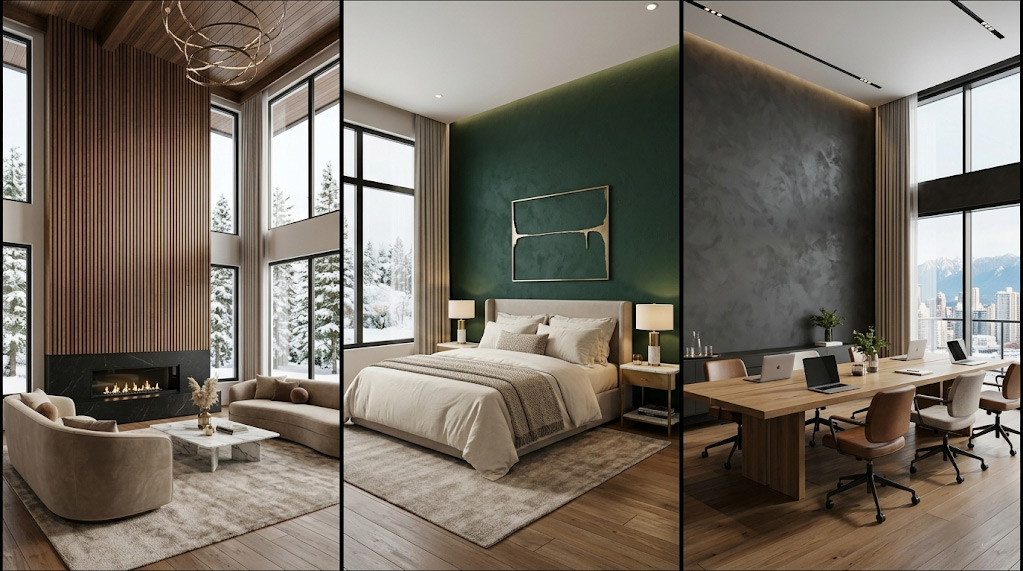
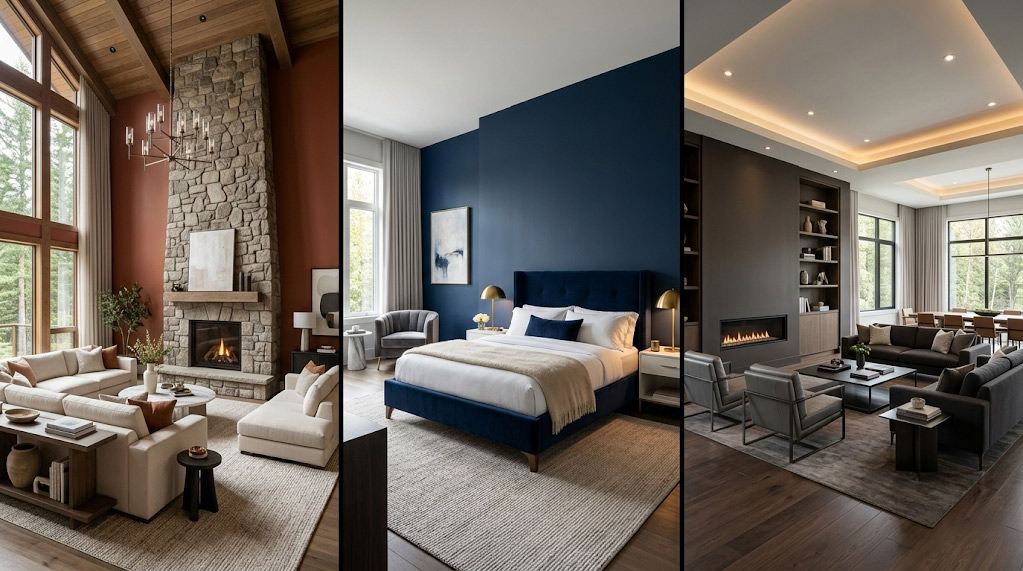
You have the paint swatch. You have the painter booked. But you are stuck on the single most expensive question in interior design: Which wall do I actually paint?
In my years of experience4 as a Principal Designer for Accent Wall Authority, I have walked into hundreds of Toronto homes where homeowners, paralyzed by “decision fatigue,” defaulted to painting the largest empty wall.
This is almost always a mistake.
Choosing an accent wall is not a creative decision; it is an architectural one. Whether you are dealing with a 12x14ft builder-grade living room in Mississauga, a narrow Victorian semi-detached in Leslieville, or a 600 sq. ft. glass-box condo downtown, the “right” wall is dictated by sightlines, focal points, and room geometry.
This guide replaces Pinterest trends with architectural rules. Here is exactly how to decide.
⚡ THE SHORT ANSWER
Comparison Table: Wrong Wall vs Right Wall
Before we analyze specific rooms, reference this architectural hierarchy. This table solves 90% of layout disputes.
| Room Type | Common Mistake (Wrong Wall) | Architectural Rule (Right Wall) | Why It Works |
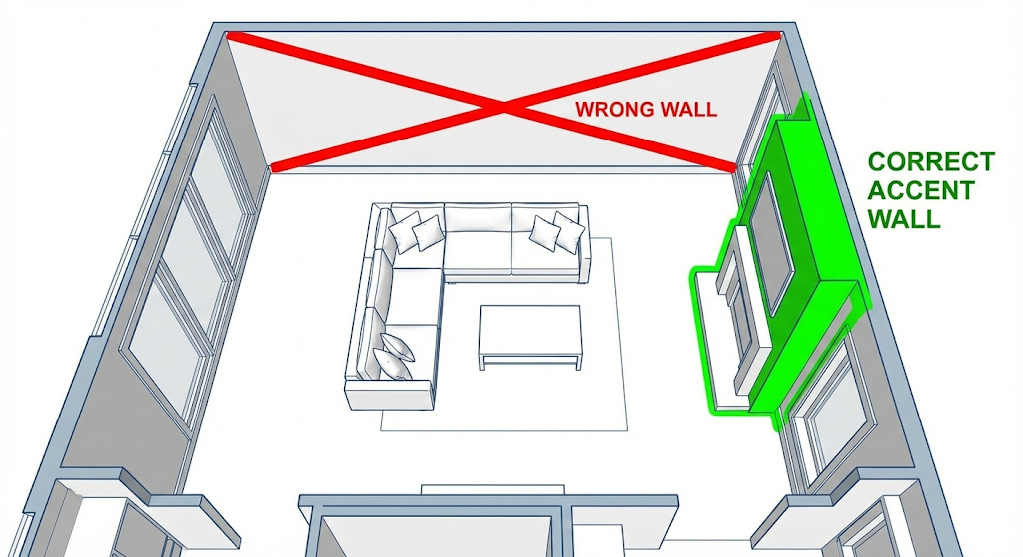
| Living Room | Longest / Empty wall | TV / Fireplace / Entry Wall | Creates a natural focal point where the eye already rests. |
| Small Living Room | Feature / Long wall | Shortest Wall | Reduces “tunnel effect” and doubles perceived width. |
| Bedroom | Window wall | Headboard Wall | Anchors the furniture (bed) as the hero of the room. |
| Open Concept | Kitchen divider / Bulkhead | Shared Axis Wall | Unifies multiple zones (dining & living) into one cohesive space. |
Living Room Accent Wall: TV Wall vs Fireplace vs Entry (The 3 Options)
In a standard Canadian living room (typically 12x14ft or larger), your furniture is oriented toward a specific purpose. Your accent wall must support that purpose, not compete with it.
1. Why the TV Wall Works Best
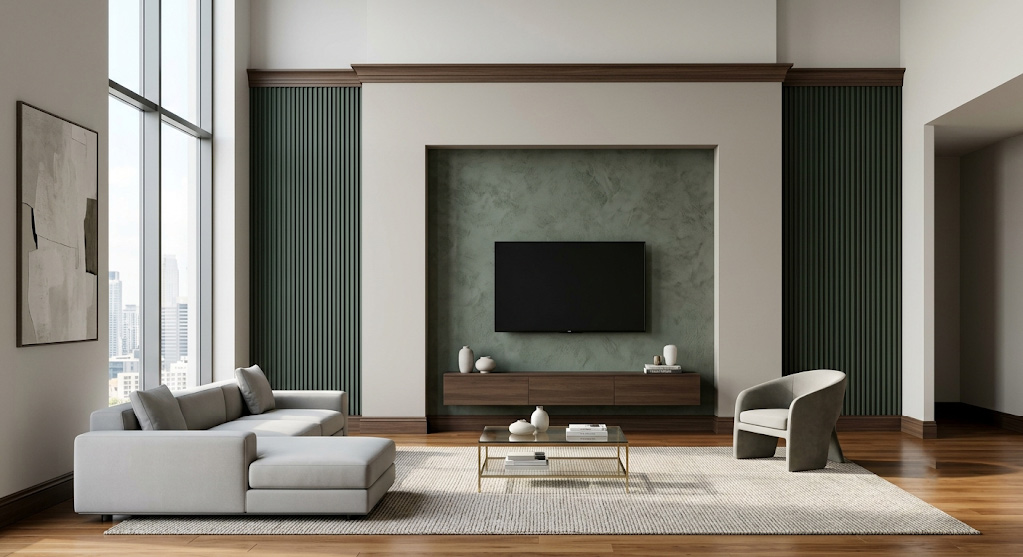
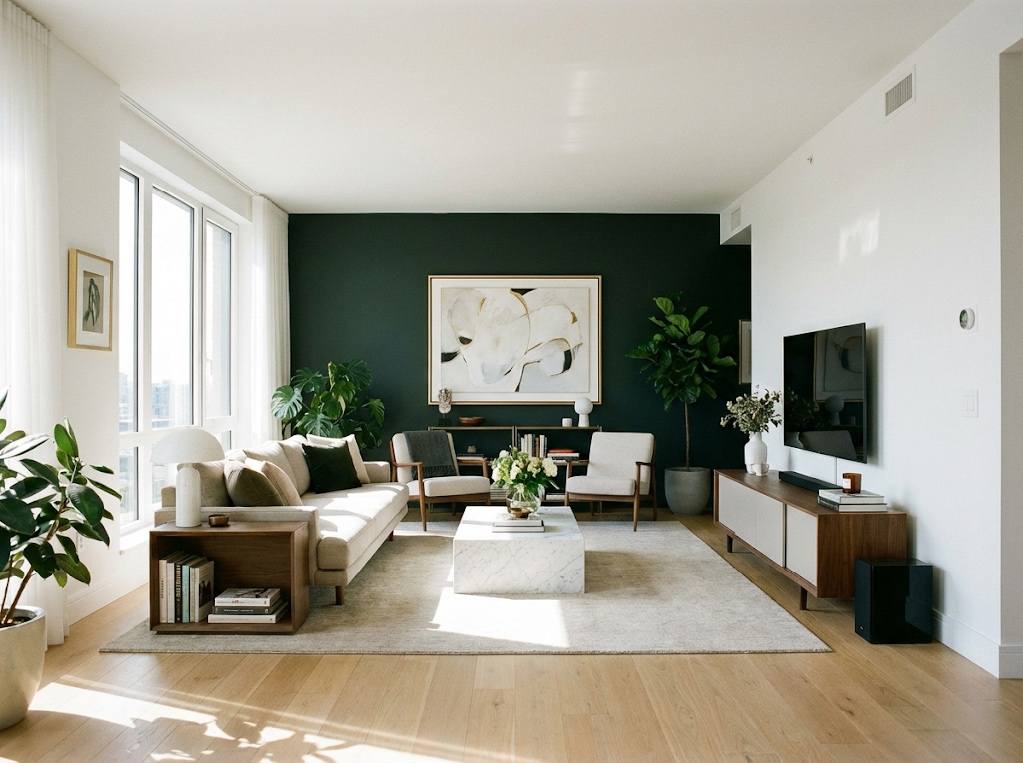
In modern homes without a fireplace, the TV wall is the undisputed king. When you sit down, you face the TV. If you accent the wall behind the sofa, you are creating a focal point that you physically turn your back on to use the room. Furthermore, when you enter the room, the sofa typically blocks the bottom third of that wall, visually cutting your accent in half.
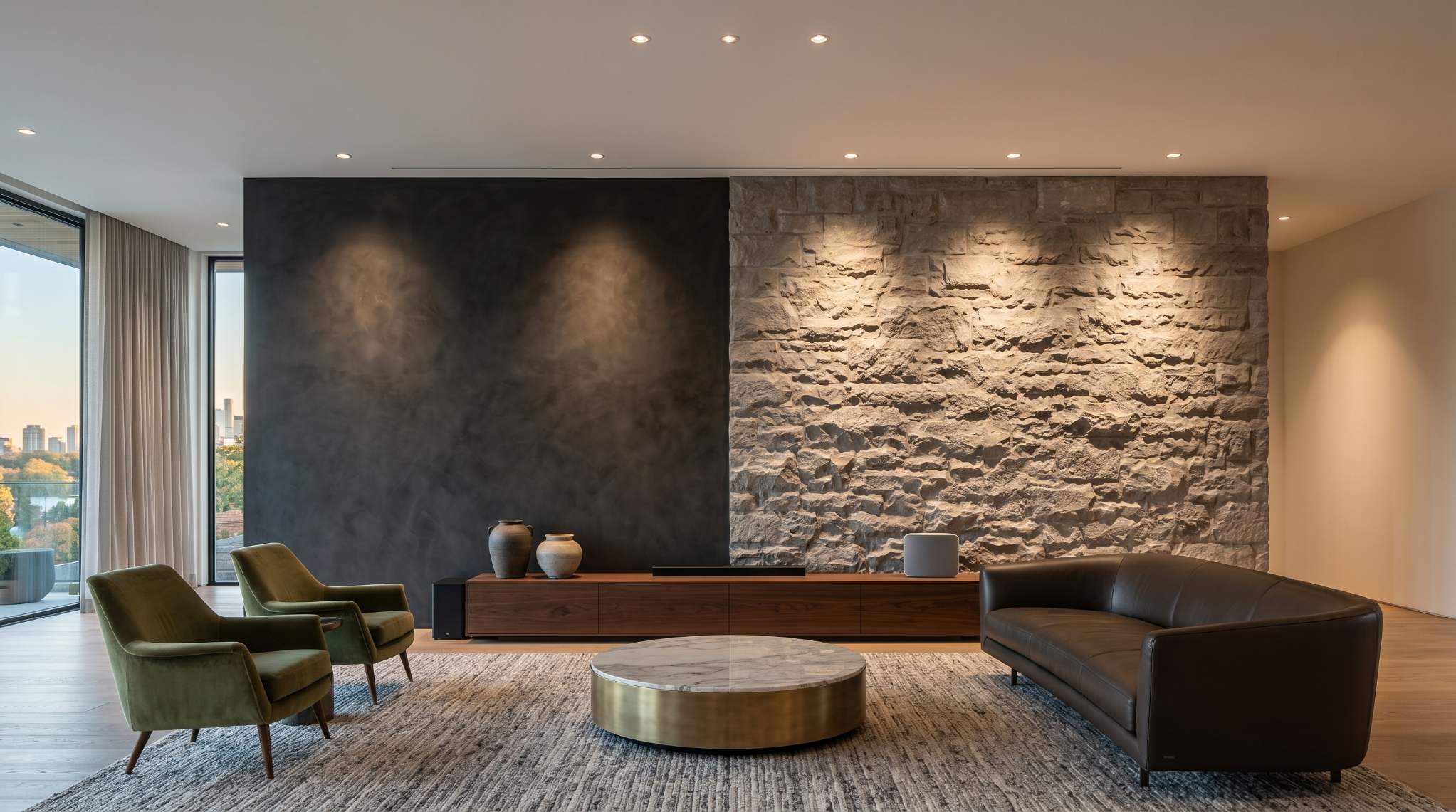
- The “Camouflage” Effect: A dark accent wall (Navy, Charcoal, Black Forest Green) behind a TV camouflages the “black hole” of the screen when it is off.
- Glare Reduction: Matte-finished accent walls behind a TV absorb light, reducing eye strain during movie nights. This is a crucial factor in bright, south-facing GTA condos.
2. Fireplace Wall: When It’s Perfect
If you have a fireplace, that is your architectural hierarchy winner. Even if the fireplace is gas and off-center (common in suburban new builds), accenting the entire chimney breast or the full wall creates grandeur.
- The Hierarchy: If your TV is on one wall and your fireplace is on another, choose the fireplace wall. It is a permanent architectural feature; the TV is just an appliance.
3. Entry View Wall: The “First Impression” Rule
Stand at the main entrance of the living room. Look straight ahead. The wall directly in your sightline is your “Entry View” wall.
- Why it works: It sets the mood immediately upon entering.
- When to use it: If your room has no TV and no fireplace (e.g., a formal sitting room), the Entry View wall becomes the default accent wall.
Small Living Room Accent Wall: The Space-Doubling Secret
This is the most counter-intuitive rule in design, yet it is critical for condo living and narrow semi-detached homes.
The “Bowling Alley” Effect
In a narrow rectangular room (common in Toronto condos or townhomes), homeowners often paint the longest wall because it offers the most surface area. This is a critical error.
- The Problem: Darkening the long wall emphasizes the length, creating a “tunnel” or “bowling alley” effect that makes the room feel claustrophobic.
- The Solution: Paint the short wall at the far end. A dark color on the far wall visually “pulls” that wall closer to you (warm colors advance; dark values add weight). This foreshortening effect tricks the brain into perceiving the room as more square and balanced, rather than long and thin.
Canadian Condo Logic
If your small living room ends in a sliding glass door to a balcony (the “window wall”), do not paint it. The contrast between a dark wall and bright exterior light creates glare (silhouetting). In this specific case, use the 90/10 Rule (see below) to choose the cleanest perpendicular wall.
Bedroom Accent Wall: Headboard Wall (The Single Exception)
In a bedroom, furniture dictates architecture. The bed is the “hero” object, and the wall anchoring it must support that status.
The King Wall Principle
The wall behind the headboard is known as the “King Wall.”
- Anchoring: Without an accent, a bed can feel like it is floating in a white box. A wood slat wall, moulding grid, or deep paint color visually “holds” the headboard, giving the room a sense of stability and protection.
- Symmetry: Most 10x12ft bedrooms are designed for the bed to be centered on one specific wall. Highlighting this wall reinforces the intended symmetry.
The Window Exception
In many modern corner-unit condos, the only logical place for the bed is against a floor-to-ceiling window wall.
- Do not accent the window wall. You cannot fight natural light with paint. The light will bleed around the edges, washing out the color and making the wall look black/silhouetted during the day.
- The Fix: Accent the solid wall perpendicular to the window. This draws the eye inward and creates a cozy “cove” for the bed without fighting the glare.
Open Concept Accent Wall: Unify, Don’t Divide
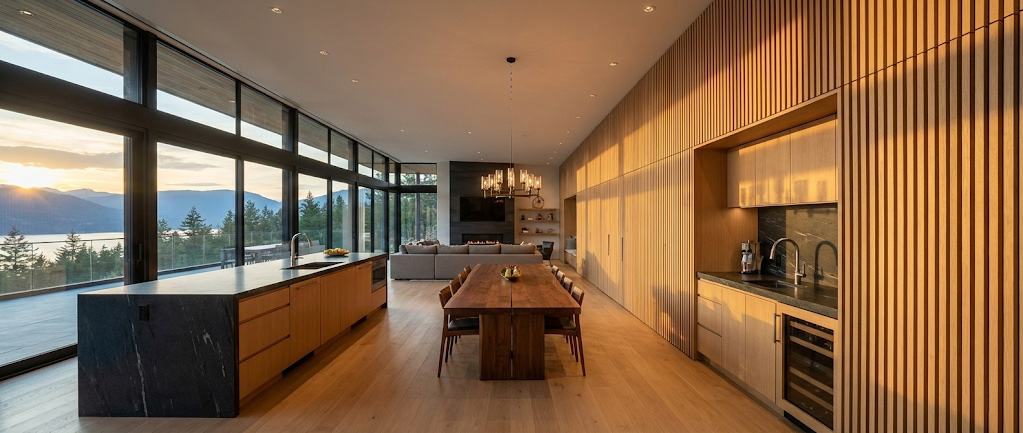
Open-concept layouts (standard in post-2010 Canadian homes) suffer from a lack of definition. Homeowners often try to “zone” these spaces by painting small, choppy walls (like a kitchen bulkhead or a short hallway divider). This fragments the space, making it look cluttered and cheap.
The Shared Axis Strategy
Look for the longest uninterrupted wall that spans multiple zones. For example, a wall that starts in the dining area and runs all the way into the living room.
- Why it works: By treating this entire length as one accent wall (perhaps with wainscoting or a cohesive colour), you visually stitch the zones together. This emphasizes the sheer size of the open footprint, increasing perceived value.
- The Divider Mistake: Never accent a wall smaller than 8 feet wide in an open concept space. If it’s a pillar or a divider, leave it neutral (Cloud White/Chantilly Lace) so it disappears.
VISUAL DIAGRAM DESCRIPTIONS
The 90/10 Rule (Works For Every Room)
If you are still stuck (perhaps you have an L-shaped basement or a converted attic) use the rule professional designers use to make decisions in seconds.
The Decision Framework:
- Stand at the entrance. Use the doorway you use most often.
- Look straight ahead. Do not turn your head.
- The wall in your direct line of sight is your accent wall.
- 90% Success Rate: In almost every case, the wall facing the entrance is the “impact wall.” Painting the wall behind the door (the one you don’t see until you walk in and turn around) wastes the investment.
- 10% Exception: Override this rule only if the entry-facing wall is structurally ugly (e.g., covered in bulkheads, irregular bump-outs, or unmatched windows). In that case, choose the next largest clean wall.
FAQ SECTION
- Should the accent wall be the longest wall?
Not necessarily; in a rectangular room, accenting the longest wall can create a “tunnel” effect, whereas accenting the focal point (TV/Fireplace) is architecturally superior regardless of length.
- Can I have 2 accent walls in one room?
No, two accent walls usually create visual chaos and a “sandwich” effect; if you want more color, paint all four walls (color drenching) rather than just two.
- What if my living room has no TV or fireplace?
Use the “Entry View” rule: accent the wall that is directly opposite the main entrance to establish a first impression focal point.
- North-facing room: does this change the rules?
The placement rules remain the same, but the color choice changes; in Canadian north-facing rooms, avoid cool greys/blues on the accent wall as they will look flat, so opt for warmer, saturated tones instead.
- Rental property: can I still do an accent wall?
Yes, peel-and-stick wallpaper or temporary decals should follow the exact same architectural rules (Headboard wall or TV wall) for maximum impact.
- Does accent wall placement matter for resale?
Yes, a correctly placed accent wall (TV or Fireplace) creates perceived value by defining the room’s function, whereas a random painted wall can be viewed as “work” for the buyer to fix.
The 4 Architectural Rules Recap
Conclusion
90% of accent wall mistakes happen because homeowners confuse “decorating” with “architecture.” They pick a wall because it’s empty, not because it anchors the room.
When you follow these architectural rules, your accent wall stops being just a coat of paint and becomes a renovation tool. It corrects room proportions, directs the eye, and unifies open spaces.
Don’t risk your home’s value on a guess.
If your room layout is unique or you need professional validation before you commit, we can help.